Whoever Holds the Ledger
AI can read the invoice. But reading a transaction and resolving it are two very different things.
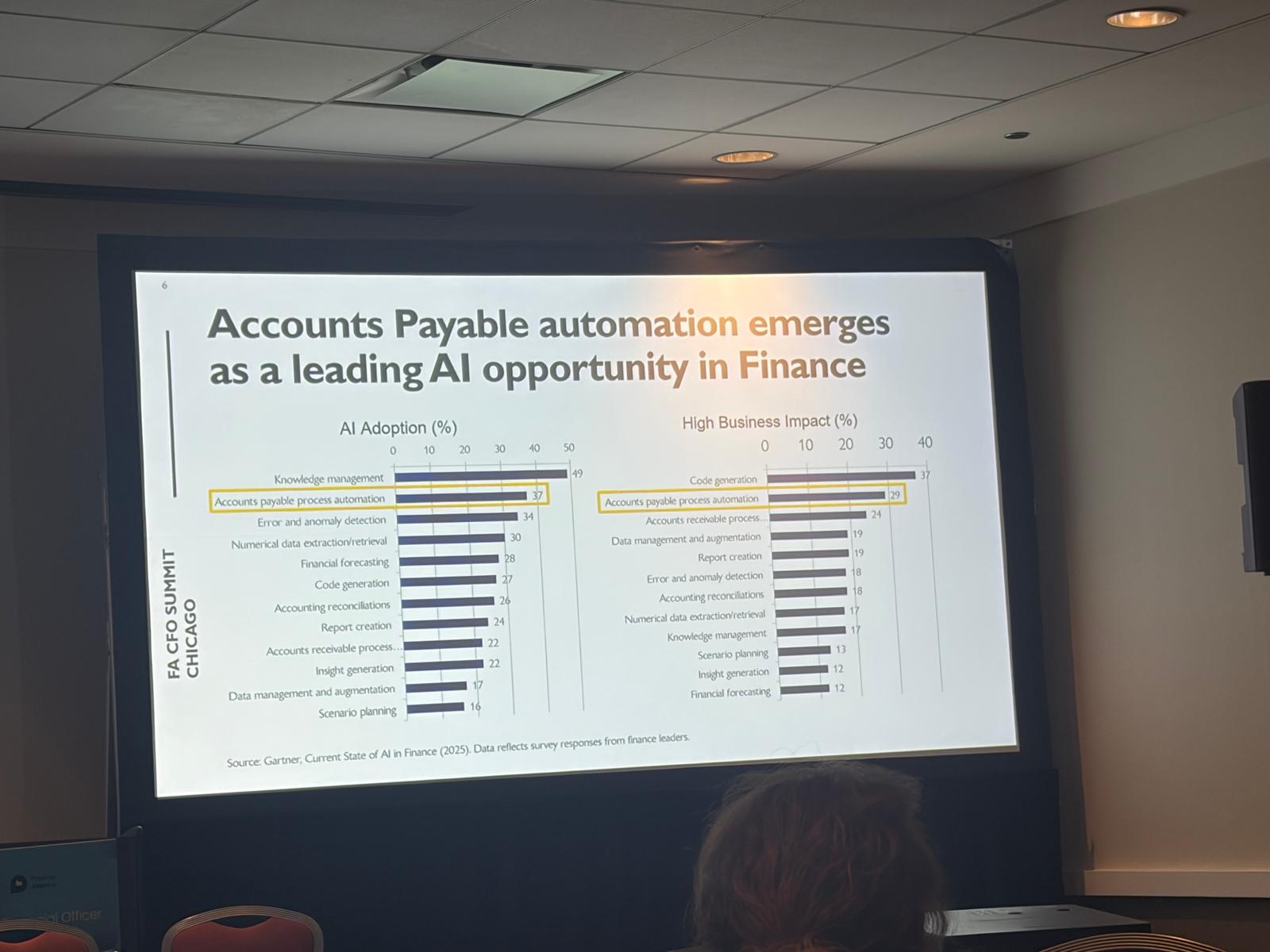
At the FA CFO Summit in Chicago this week, a slide based on Gartner's Current State of AI in Finance, 2025 identified accounts payable automation as a leading AI opportunity in finance.
I discussed it, along with the AP cost simulator I built from the same session, with a friend who spent his entire career as a CFO.
His response was quicker than any AI model:
AP has been ready to be computerised for years.
He was right.
The interesting question is not why accounts payable has suddenly become an AI opportunity. It is why, after decades of automation attempts, so much of the process still requires human intervention.
The answer has surprisingly little to do with reading invoices.
It has everything to do with who controls the underlying transaction.
The Gartner slide is interesting, but it deserves a closer reading.
Accounts payable automation appears in the top two use cases for both AI adoption and perceived business impact. Knowledge management leads adoption at 49%, while code generation leads perceived impact at 37%. AP sits second in both categories.
Three qualifications matter.
First, the survey covered 183 CFOs and senior finance leaders, but the adoption figures relate to organisations already using AI in finance. Gartner reported that 59% of respondents were using AI in their finance functions. The 37% AP figure therefore does not mean that 37% of all finance functions have adopted AP automation.
Second, the research dates from May and June 2025. Subsequent Gartner research in 2026 has continued to identify finance automation as an area of measurable value, but the original slide should not be mistaken for a current adoption census.
Third, adoption and business impact are not necessarily measured against identical populations. We should be careful about comparing the two columns as if they were directly equivalent.
Nevertheless, the pattern is revealing.
Knowledge management is widely adopted, but widespread adoption does not automatically translate into the highest measurable business impact. AP automation sits in a different category: its output is tangible. An invoice is captured, matched, approved, posted and paid.
The result is measurable.
This distinction matters. Finance does not need another impressive AI demonstration. It needs technology that changes the economics of running the function.
My CFO friend described the problem in two observations.
First:
The process is better (speedier and more accurate) done by machines. The challenge has always been in moving the supplier base to a uniform machine-readable input mechanism.
Second, even when a third-party AP system can process invoices effectively, it still needs to interface with the established accounting packages. Those systems have little incentive to make it easy for external products to replace functionality they can provide themselves.
Both observations remain relevant. But AI has changed the economics of the first, while the second has become a more interesting architectural question.
The input problem
For decades, the conventional answer was to make suppliers change how they submitted invoices.
EDI, supplier portals, standardised templates and electronic invoicing networks all attempted to impose a degree of consistency on the input.
The approach works, but it requires cooperation across an entire supplier ecosystem. Large organisations may have thousands of suppliers, many of whom have neither the technology nor the incentive to adopt a particular buyer's preferred format.
Europe is moving towards greater standardisation through regulation. Belgium introduced mandatory structured B2B e-invoicing from January 2026, while the EU's VAT in the Digital Age programme establishes a broader framework for digital reporting and cross-border transactions.
The US has no equivalent federal B2B e-invoicing mandate.
AI changes the equation.
Modern document-processing models can interpret invoices arriving as PDFs, scanned documents or other inconsistent formats, extracting relevant information without requiring every supplier to adopt the buyer's preferred template.
The buyer can increasingly solve the input problem independently.
This is a genuine shift. It does not eliminate the value of structured invoicing, authenticated supplier networks or common standards. Those remain important for interoperability, validation and fraud prevention.
But it reduces the need to make every supplier change before automation can begin.
The accounting package
My friend's second observation is more consequential.
Historically, established accounting and ERP vendors could protect their position by controlling access to the systems where financial transactions were recorded and managed.
A third-party AP provider might offer better invoice processing, but it still needed to connect to the ERP to retrieve purchase orders, validate suppliers, resolve discrepancies and ultimately post transactions.
In 2026, the competitive landscape is changing.
Oracle is bringing AI agents into its Fusion applications, including payables. SAP is developing AI-driven invoice orchestration. Other major financial software providers are pursuing similar strategies.
The incumbents are no longer simply opening their platforms to external AI products. They are incorporating intelligence into the systems that already control the underlying business processes.
This creates a structural advantage.
But it is important to understand exactly where that advantage comes from.
It is not simply that the ERP contains the ledger.
It is that the ERP, or the surrounding enterprise systems, often hold the context required to understand and resolve the transaction.
Reading an invoice was never where most of the operational complexity sat.
Ardent Partners' 2026 benchmarks put the average cost of processing an invoice at $9.90, compared with $2.67 for best-in-class organisations. Its reported average exception rate is 19.9%.
Nearly one invoice in five requires intervention.
Improving document extraction is useful, but it does not automatically eliminate the reasons those invoices need attention.
Consider a single invoice moving through the process.
1 Capture
A supplier emails a PDF. An AI model extracts the supplier, invoice number, dates, line items, tax amounts and payment details.
This is increasingly commoditised.
The challenge is no longer simply reading the document. It is validating what has been read and establishing whether it represents a legitimate transaction.
2 Match
The invoice is compared against the purchase order and goods receipt.
The price may be different from the agreed amount. The quantity may not match what was delivered. The warehouse may not yet have recorded receipt of the goods.
A model can identify the discrepancy.
But identifying a discrepancy does not resolve it.
Someone, or something with the appropriate authority, must establish what actually happened.
3 Validate the supplier
The bank details on the invoice are compared against the supplier master record.
A model can read a fraudulent bank account number just as accurately as a legitimate one.
Email-delivered invoices also remain vulnerable to business email compromise, where attackers manipulate payment instructions.
A reliable process needs independent verification, trusted supplier records and controls over changes to payment details.
AI extraction alone does not provide these assurances.
4 Approve and pay
Approval routes depend on organisational structures, spending limits, delegated authority and financial controls.
Payment introduces another set of requirements, including banking integration, segregation of duties and authorisation.
An AI agent might identify an invoice that should be paid. That does not necessarily mean it should be permitted to release the payment.
The distinction between identifying, recommending and authorising an action is fundamental.
The pattern is consistent.
The information required to resolve an exception is distributed across the enterprise.
Purchase orders sit in procurement systems. Goods receipts sit in inventory or warehouse systems. Supplier records sit in master data. Approval hierarchies sit in organisational and financial systems. Payment instructions sit within controlled banking workflows.
The invoice is only one part of the transaction.
An AI system can read it perfectly and still be unable to complete the process.
This is why the location of the AI matters less than its relationship with the underlying enterprise architecture.
There is an important distinction between access to data and authority to act on it.
A standalone AP platform with authorised access to purchase orders, supplier records, receipts and approval workflows may be perfectly capable of resolving exceptions.
An ERP-native agent may have a more direct route to those capabilities, but it is not automatically more intelligent or more effective.
Equally, a supplier network that improves the quality and authenticity of incoming invoices may prevent many exceptions from occurring in the first place.
There are therefore three sources of advantage:
- Context: access to the information required to understand the transaction.
- Authority: permission to make decisions or initiate actions within defined boundaries.
- Execution: the ability to resolve exceptions and complete the transaction within the established controls.
The strongest solutions will bring these three together.
This is also where enterprise AI architecture becomes a governance problem rather than simply a technology problem.
An agent needs to know what it can see, what it can change, what it can approve and what must be escalated to a person.
A system that can identify a discrepancy but cannot resolve it has automated detection.
A system that can resolve it within appropriate controls has automated work.
There is a considerable difference.
For CFOs evaluating AP automation, this changes the questions worth asking.
Instead of focusing primarily on extraction accuracy, measure:
- The percentage of invoices processed without human intervention.
- The proportion of exceptions resolved automatically.
- The average cost of resolving an exception.
- The time between invoice receipt and payment approval.
- The frequency of incorrect supplier or payment data.
- The percentage of transactions requiring manual reconciliation.
These measures tell you whether the technology is improving the economics of the process, rather than simply making one step faster.
AI has changed the economics of accounts payable by reducing the need to standardise every supplier input before automation can begin.
But the remaining value is concentrated elsewhere.
It sits in the ability to understand the transaction, reconcile it against the rest of the business, resolve discrepancies and execute the outcome within appropriate controls.
This is where the underlying enterprise architecture becomes strategically important.
The ERP has a structural advantage because it often holds the transaction context and controls the financial record. But that advantage is not exclusive. Independent platforms with sufficient access, authority and execution capability can compete effectively.
The distinction is not between AI inside the ERP and AI outside it.
It is between AI that can read a transaction and AI that can resolve one.
I would make a testable prediction: over the next two years, the AP solutions that deliver the greatest measurable improvements will be those that combine document intelligence with direct access to purchasing, supplier and financial workflows.
Standalone tools that only extract invoice data will struggle to capture the same value. Those that own the supplier network, exception workflow or authorised integration into the systems of record have a much stronger proposition.
If independent platforms demonstrate equivalent or better exception resolution at comparable customers, that prediction is wrong.
And I will say so.
Before buying AP AI, measure where the cost actually sits. Then buy from whoever can resolve it.
The model may read the invoice. But whoever controls the transaction determines what happens next.
- Gartner press release: Finance AI adoption remains steady in 2025 (183 leaders, May–June 2025; 59% adoption)
- Gartner: Current State of AI in Finance, 2025 (abstract)
- CFO Dive: Gartner on AI time-to-value in finance (160 leaders, Jan–Apr 2026)
- Medius: Ardent Partners, AP Metrics that Matter in 2026 (exception rates, AI use)
- Tailride: Invoice management statistics 2026 (Ardent 2026 cost per invoice, as summarised)
- Oracle: Agentic AI in ERP, four agents in Release 26B
- Oracle: Payables Agent and electronic invoicing
- SAP: Invoicing Orchestration Agent
- TechnologyAdvice: AI in ERP
- SPS Commerce: E-invoicing mandates in Europe, 2026